Are First Aid Courses Tax Deductible? Complete Guide
If you’ve recently completed a first aid course for work, you may be wondering whether you can claim the cost at tax time. The good news is that, in many situations, you can.

In Short
- Many first aid courses are tax deductible. You may be able to claim the cost of first aid training if it’s directly related to your current job and you paid for the course yourself.
- If your employer paid for your first aid or CPR course, you generally can’t claim it as a tax deduction.
- The training must maintain or improve your existing work skills. First aid courses completed to help you change careers or secure a new job are generally not deductible under ATO guidelines.
- Employees and self-employed workers may be eligible. Healthcare workers, teachers, childcare educators, tradies, personal trainers and many business owners can often claim first aid training when it’s relevant to their work.
Are first aid courses tax deductible? It depends on why you completed the training and how it relates to your current employment. The Australian Taxation Office (ATO) allows deductions for some work-related education and training expenses, including first aid courses, provided they help you maintain or improve the skills you need in your existing job.
Understanding the ATO’s rules can help you understand if you’re eligible to claim the cost of your training, no matter your profession. In this guide, we’ll explain when first aid courses are tax deductible, who can usually claim them, when you can’t claim them, and what records you’ll need to keep.
Can You Claim First Aid on Tax in Australia?
In many cases, you can claim first aid on tax. If the training is directly related to your current employment and you paid for the course yourself, you may be able to claim it as a work-related self-education expense.
However, not every first aid course is automatically tax deductible. Generally, you may be able to claim the cost if:
- the course is directly related to your current job
- it helps you maintain or improve the skills required in your role
- your employer requires you to hold a current first aid qualification
- you paid for the course yourself and weren’t reimbursed.
If the course was undertaken to help you get a new job, change careers or start working in a different industry, it generally won’t be deductible.

What Does the ATO Say About First Aid Training?
The Australian Taxation Office allows deductions for self-education expenses where the training has a sufficient connection to your current job. In simple terms, if your first aid training helps you perform your existing job more effectively or is required as part of your employment, the cost may be deductible.
On the other hand, if the course is designed to help you qualify for a new occupation or begin a different career, the expense is generally considered private and cannot be claimed.
The same principles apply whether you’re completing a full HLTAID011 Provide First Aid course, an annual CPR refresher or another nationally recognised first aid qualification.
Because every person’s circumstances are different, it’s important to ensure your claim meets the ATO’s eligibility requirements.
When Is First Aid Training Tax Deductible?
Yes, it is, but not in every situation. Your ability to claim a first aid course on tax depends on why you completed the training and how it relates to your current job.
In many cases, you may be able to claim the cost of your training if it helps you maintain or improve the skills you need in your existing role and you meet the Australian Taxation Office’s (ATO) eligibility requirements. Some of the most common situations where you may be able to claim first aid training include:

Your Employer Requires You to Hold a Current First Aid Certificate
Many industries require employees to maintain a current first aid qualification. If your employer requires you to complete first aid training but doesn’t reimburse the cost, you can generally claim the expense as a work-related deduction.
This commonly applies in industries such as childcare, education, healthcare, construction, aged care and fitness.
You’re the Workplace First Aid Officer
Many Australian workplaces appoint designated First Aid Officers to respond to medical emergencies.
If you’re required to undertake first aid training to fulfil this responsibility and you pay for the course yourself, the cost will often be deductible.
The Training Maintains Skills You Already Use
Even if every employee isn’t required to hold a first aid certificate, your training may still be deductible if maintaining first aid skills forms part of your regular duties.
The key consideration is whether the course helps you continue performing your existing role rather than preparing you for a different occupation.
You’re Self-Employed
If you’re self-employed or operate your own business, first aid training may be deductible where it’s relevant to the services you provide. For example, personal trainers, tradespeople, outdoor instructors, childcare business owners and many health professionals may be able to claim the cost as a legitimate business expense.

Who Can Claim a First Aid Course?
Eligibility depends on your individual circumstances, but people working in the following occupations can often claim first aid training where it’s required for their role.
Healthcare Workers
Nurses, doctors, allied health professionals, paramedics and other healthcare workers frequently require current first aid and CPR qualifications as part of their employment.
Where the training maintains professional skills and isn’t reimbursed, it may be deductible.
Childcare and Education Professionals
Teachers, early childhood educators, teacher aides and childcare workers are commonly required to maintain current first aid qualifications. If you pay for your own training, you may be eligible to claim the cost.
Construction Workers and Tradies
Construction workers, electricians, plumbers, carpenters and other tradespeople often complete first aid training to meet workplace safety requirements.
Where the course relates to your current employment, the expense may qualify as a tax deduction.
Personal Trainers and Fitness Professionals
Many gyms, sporting organisations and insurers require personal trainers to hold a current first aid certificate and annual CPR certification. If you’re employed as a fitness professional or operate your own business, first aid training may be deductible.
Security Personnel
Security guards regularly complete first aid training to improve workplace safety and respond to emergencies.
If your employer requires this qualification or it’s directly related to your role, you may be able to claim it.

Aged Care and Disability Support Workers
Workers supporting elderly Australians or people living with disability frequently require first aid certification as part of industry compliance. Where the course maintains your existing skills, it may be tax deductible.



When Can’t You Claim First Aid on Tax?
Although many workers are eligible, there are situations where first aid training isn’t deductible. Generally, you can’t claim your first aid course if:
- your employer paid for or reimbursed the training
- you completed the course before starting your current job
- you’re taking the course to help change careers
- you’re studying to qualify for a new occupation
- the training isn’t connected to your current income-producing activities.
For example, someone completing a first aid course before applying for a childcare position generally can’t claim the expense because the course is helping them obtain new employment rather than maintain existing work skills.
Similarly, students completing first aid as part of a qualification before entering the workforce generally won’t be able to claim the cost.
Can You Claim a CPR Course on Tax?
Many people complete annual CPR refresher training rather than a full first aid course. The same principles generally apply.
If your CPR qualification is required for your current employment and you pay for the course yourself, you may be able to claim it as a work-related expense. This commonly applies to:
- personal trainers
- nurses
- childcare educators
- swimming instructors
- healthcare professionals
- lifeguards
- first aid officers.
If your employer reimburses the cost, you can’t claim that amount.

Real Examples of Tax-Deductible First Aid Training
The ATO’s rules can seem a little confusing when you first read them. Looking at a few real-world scenarios can make it easier to understand when a first aid course is likely to be tax deductible and when it isn’t.
Construction worker – A construction worker completes a first aid course because it’s required by their employer and pays for the training themselves. Deductible? Likely
Teacher – A primary school teacher renews their first aid qualification to comply with school policies and pays the course fee personally. Deductible? Likely
Personal trainer – A self-employed personal trainer renews their first aid and CPR certification to meet insurance and industry requirements. Deductible? Likely (as a business expense).
University student – A student studying nursing completes first aid training before obtaining employment. Deductible? Unlikely. Generally not deductible.
Career changer – An office worker completes a first aid course before applying for jobs in childcare. Deductible? Unlikely. Generally not deductible because the training is undertaken to obtain new employment.
What Records Should You Keep?
If you’re planning to claim first aid training on your tax return, good record keeping is essential. The ATO may ask you to substantiate your claim, so retain:
- your tax invoice or receipt
- proof of payment
- your certificate of completion
- course enrolment details
- documentation showing the course was required for your role where applicable.
Keeping these records makes it much easier to support your claim if required.

Common Mistakes When Claiming First Aid Training
It’s also important to understand what can’t be claimed. A common mistake is assuming that all first aid courses are automatically tax deductible. In reality, you generally can’t claim training that was paid for or reimbursed by your employer, completed before you started your current job, or undertaken to help you change careers or qualify for a new occupation.
It’s equally important to keep records of your expenses, including receipts and proof of payment, as the ATO may ask you to substantiate your claim. If you’re unsure whether your first aid training is deductible, it’s always worth checking the ATO’s guidance or speaking with a registered tax agent before lodging your tax return.
Frequently Asked Questions
How much can you actually claim back on a first aid course?
You can claim the full cost of the course as a deduction, not a refund. So what you get back depends on your marginal tax rate. If you paid $100 for a first aid course and you’re in the 32.5% tax bracket, you’d reduce your tax bill by around $32.50. The higher your income, the more you save. Keep in mind this only applies if you’re eligible to claim in the first place.
Can you claim travel costs to get to your first aid course?
Possibly. If the course is tax deductible, you may also be able to claim the travel costs to get there, such as public transport fares or a cents-per-kilometre calculation if you drove. This generally applies when you travel directly from work to the training venue. Travel from home to the course is usually treated the same as a regular commute and isn’t claimable.
Does it matter if you completed the course online instead of face-to-face?
No. The ATO doesn’t distinguish between online and face-to-face delivery when assessing whether a course is deductible. What matters is the connection between the training and your current employment, not how it was delivered. So an online CPR refresher course is treated the same as an in-person one for tax purposes.
Can you claim first aid training in the same year you renew, or only once?
You can claim it every time you renew, as long as you continue to meet the eligibility requirements. First aid certificates need to be renewed every three years, with an annual CPR update. Each renewal is a separate expense and can be claimed in the financial year you paid for it, provided the course remains connected to your current employment.
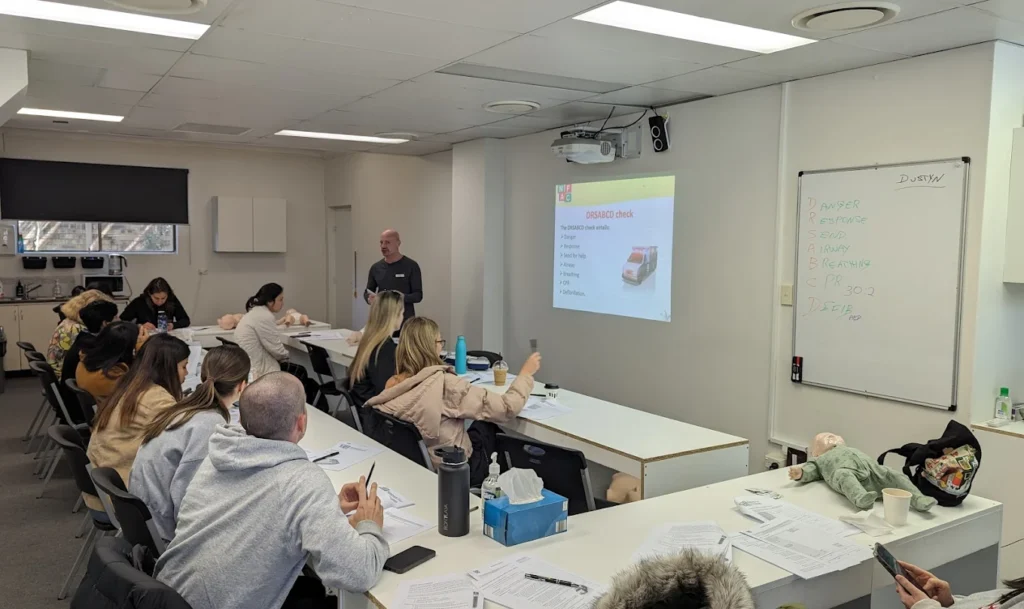
Get Your First Aid Certification at a Training Location Near You
Ready to gain the essential skills and knowledge to enhance your resume and advance your career? Look no further than National First Aid Courses, Australia’s leading First Aid Course provider.
As a Registered Training Organisation (RTO 41072), we guarantee you will receive the highest standard of training.
We offer official, accredited, nationally recognised First Aid training at affordable prices.
Our comprehensive First Aid Courses are designed to equip you with the knowledge and certifications needed to provide life-saving assistance in emergency situations.
With face-to-face instruction, same-day certificates, and convenient locations across New South Wales and Queensland (including Sydney, Brisbane and the Gold Coast) we make it easy for you to become a certified First Aider. Enrol in one of our upcoming First Aid courses and secure your spot today.