Key Takeaways for First Aid Training by NFAC
- Industry-Relevant Training: Our courses are designed for workplaces and individuals across construction, healthcare, childcare, hospitality, corporate, and more.
- Compliance-Focused: All training meets Australian workplace health and safety requirements, helping employers and individuals stay legally prepared.
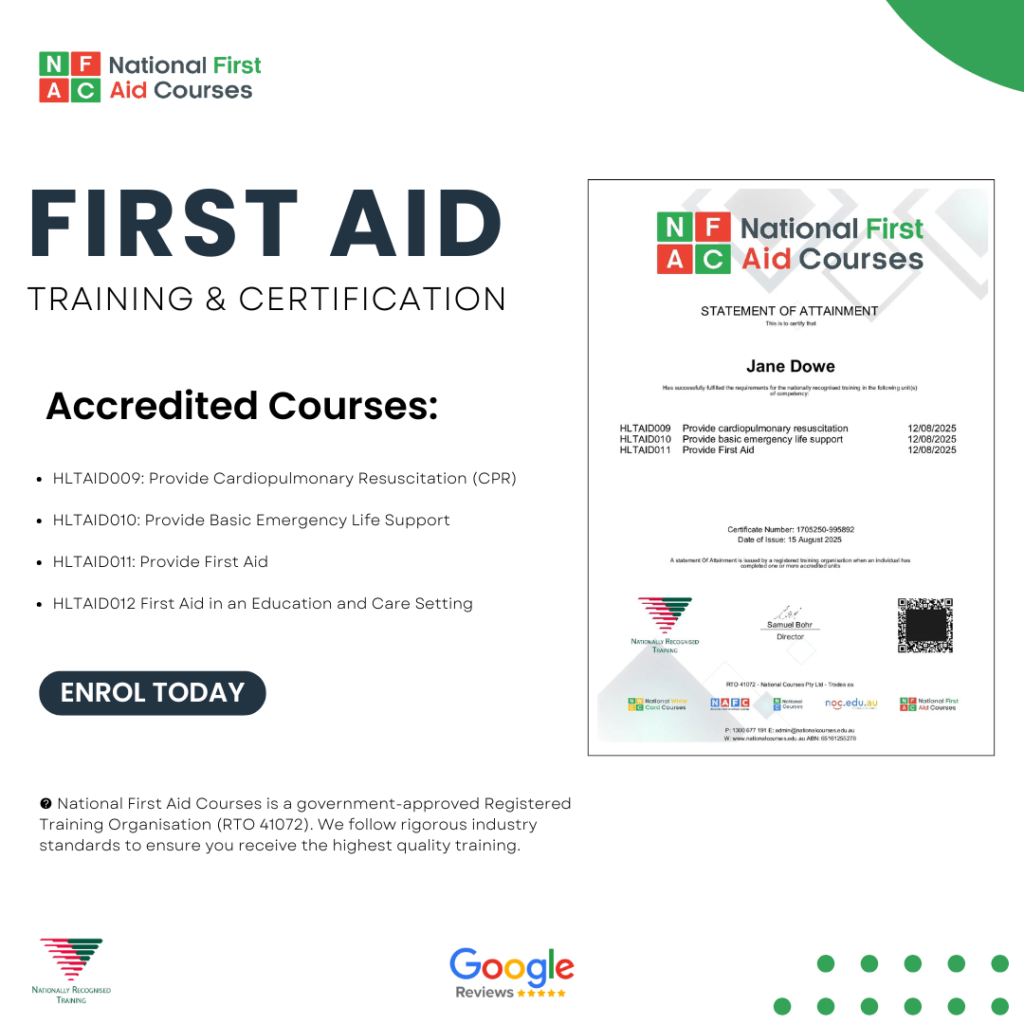
- Accredited Courses: Choose from nationally recognised options — HLTAID011 Provide First Aid, HLTAID009 CPR, and HLTAID012 Childcare First Aid.
- Practical, Face-to-Face Learning: Hands-on training with qualified trainers ensures real skills, not just theory.
- Fast Certification: Complete your course and receive your nationally recognised certificate the same day.
- Flexible Locations: Training is available across major cities and regional centres nationwide, with group and onsite options for workplaces.
If you’re completing a First Aid course with National First Aid Courses, you’ll come across a lot of health, safety, and emergency response terms — many of which you’ll use in real situations at home, work, sports events, or in the community.
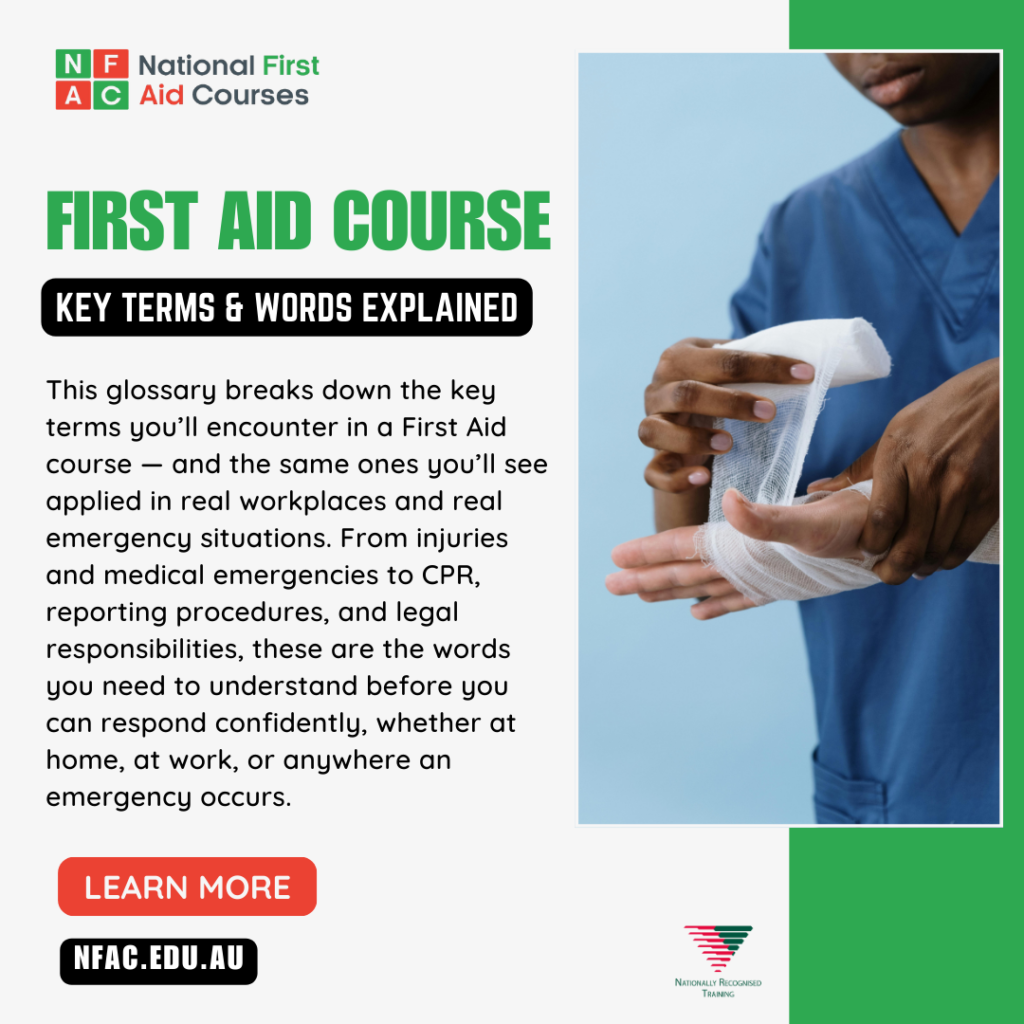
This glossary explains the key words covered in the First Aid courses in plain English, so you understand what they mean, why they matter, and how they’re applied in real-life first aid scenarios across Australia.
Whether you’re new to first aid or just want a clearer understanding of the language used during training, this guide covers the essential terms you’re expected to know before responding to any emergency.
Quick Reference Table of Terms (Click to View)
Core First Aid Concepts
- First Aid
- Emergency Procedures
- Risk
- Incident
- Near Miss
- Notifiable Incident
- Triage
- Primary Survey
- Secondary Survey
Roles & Responsibilities
Emergency & Safety Equipment
- Personal Protective Equipment (PPE)
- Automated External Defibrillator (AED)
- First Aid Kit
- Oxygen Equipment
- Bandages & Dressings
Medical Conditions & Injuries
Core First Aid Concepts – Definitions
First Aid
Immediate care given to someone who is injured or suddenly becomes ill, before professional medical help arrives.
Emergency Procedures
Predefined steps to respond to incidents such as cardiac arrest, choking, severe bleeding, or other medical emergencies.
Risk
The likelihood that a person could be harmed in a given situation and the potential severity of that harm.
Incident
Any unplanned event causing, or with the potential to cause, injury or illness.
Near Miss
An event that could have caused harm but didn’t, often providing a learning opportunity to prevent future incidents.
Notifiable Incident
A serious incident that must be reported to regulators, such as death, serious injury, or dangerous occurrence.
Triage
The process of prioritising patients or casualties according to the severity of their condition to manage emergencies effectively.
Primary Survey
The initial check for life-threatening conditions including airway, breathing, and circulation (the ABCs).
Secondary Survey
A detailed head-to-toe assessment to identify injuries or conditions after immediate life-threatening issues have been addressed.
Roles & Responsibilities – Definitions
First Aider
A trained individual who provides first aid in emergencies and maintains first aid equipment and records.
Responsible Person
A staff member or supervisor legally responsible for ensuring first aid arrangements and emergency procedures are followed.
Supervisor
Oversees team safety, ensures first aid procedures are in place, and coordinates emergency response when required.
Emergency Services
Professionals such as paramedics, firefighters, and police who provide advanced medical care and support during serious incidents.
Emergency & Safety Equipment – Definitions
Personal Protective Equipment (PPE)
Equipment or clothing designed to protect first aiders and patients from hazards, such as gloves, masks, or eye protection.
Automated External Defibrillator (AED)
Portable device that analyses heart rhythm and can deliver a shock to help restore a normal heartbeat during cardiac arrest.
First Aid Kit
A collection of supplies and equipment for administering first aid, including bandages, antiseptics, and emergency tools.
Oxygen Equipment
Devices that provide supplemental oxygen to patients in respiratory distress or shock.
Bandages & Dressings
Materials used to cover and protect wounds, control bleeding, and support injured limbs.
Medical Conditions & Injuries – Definitions
Bleeding
Loss of blood from the circulatory system, requiring control with pressure, dressings, or tourniquets in severe cases.
Shock
A life-threatening condition where blood flow to vital organs is insufficient, requiring immediate first aid and professional care.
Burns
Damage to skin or tissue from heat, chemicals, electricity, or friction. First aid focuses on cooling, covering, and preventing infection.
Fractures
Broken bones that require immobilisation, support, and medical assessment before movement.
Heart Attack
Medical emergency caused by blocked blood flow to the heart, requiring CPR, monitoring, and urgent medical attention.
Stroke
Interruption of blood flow to the brain, causing sudden symptoms like weakness, speech difficulties, or facial droop. Immediate first aid is critical.
Choking
Obstruction of the airway by a foreign object, requiring first aid techniques such as back blows, abdominal thrusts, or CPR.
Asthma
Respiratory condition causing difficulty breathing. First aid may include using a reliever inhaler and monitoring symptoms.
Allergic Reaction
Immune response that can range from mild to severe (anaphylaxis), often treated with epinephrine and monitoring vital signs.
Seizure
Sudden, uncontrolled electrical activity in the brain. First aid includes protecting the person from injury and seeking medical help.
Need to Book a First Aid Course?
Knowing first aid terms is one thing — actually applying them in an emergency is another.
Our First Aid courses are designed for both beginners and those needing a refresher. We don’t just hand you a manual — our experienced trainers bring every concept to life with realistic scenarios, hands-on exercises, and interactive learning.
You’ll quickly understand how to:
- Recognise medical emergencies before they escalate
- Provide immediate, correct first aid care
- Use first aid equipment and PPE safely
- Coordinate with other responders and emergency services
Our trainers focus on exactly what you need to stay confident, calm, and effective in real emergencies.
Your First Aid Made Easy
Getting your First Aid Certificate with NFAC is simple. We offer nationally recognised courses at multiple locations around Australia.
You’ll receive your official Statement of Attainment, on the same day, so you can start providing first aid immediately. Whether booking individually or for a group, the process is quick and straightforward.
Book your First Aid course today and take the first step toward confidence and preparedness in any emergency.
Get Government-Approved First Aid Training at a Location Near You!
Not all first aid training is created equal.
At National First Aid Courses (RTO 41072), we do things differently.
We take First Aid training seriously.
Our courses are delivered face-to-face by industry-qualified trainers who teach the skills properly — using modern equipment and realistic scenarios.
No shortcuts. No rushed online content.
Real practice, real assessment, real confidence.
We train people who need to be trusted — employees, parents, carers, students and community members.
People who can’t afford to guess in an emergency.
When you choose National First Aid Courses, you get more than a certificate — you get training that truly prepares you for real emergencies:
-
Nationally Recognised Certification — valid across every state and territory in Australia.
-
Hands-On, Face-to-Face Learning — practice skills in realistic scenarios so you leave confident and capable.
-
Same-Day Certification — complete your course and receive your certificate immediately.
-
Practical, Real-World Scenarios — training designed for actual emergencies, not just ticking boxes.
-
Accessible Locations Across Australia — major cities and regional centres, so you can train wherever it suits you.
We make it simple: straightforward booking, affordable pricing, and trainers who genuinely care about your success.
Take the first step. Book your First Aid course today and be ready anywhere, anytime.